
Test Management for Complex IT Transformations
We steer testing so that every requirement is traceably covered through to release: with a clear strategy, reliable release criteria and reports decision-makers can act on.
Focus on insurance IT, SAP and Jira/Xray
systems and 240+ interfaces in one insurance programme
projects, 8 applications and simultaneous deployments in 8 countries
Jira/Xray licences across 2 locations
Figures from project practice. Gained partly in employment, in independent engagements or via consulting partners. Client names are not disclosed.
What test management must deliver in large projects
Test management is more than testing. It connects business, development, operations and project management, and makes quality steerable.
Test Strategy & Governance
- Risk-based test approach
- Test levels and responsibilities
- Quality gates and release criteria
Planning & Resources
- Test planning in roadmap and Big Picture
- Spot dependencies and bottlenecks early
- Alignment with release planning
Execution & Control
- E2E, SIT and UAT coordination
- Test status per requirement and release
- Steering of test teams and suppliers
Defect Management
- Clear processes for logging and triage
- Prioritisation by business risk
- Transparency through to retest
Test Environments & Release
- Environment planning and booking
- Deployment readiness
- Cross-project release coordination
Reporting & Decisions
- Test coverage and quality status
- Risks and open items
- Decision papers for steering committees
Requirements, tests and defects in one chain
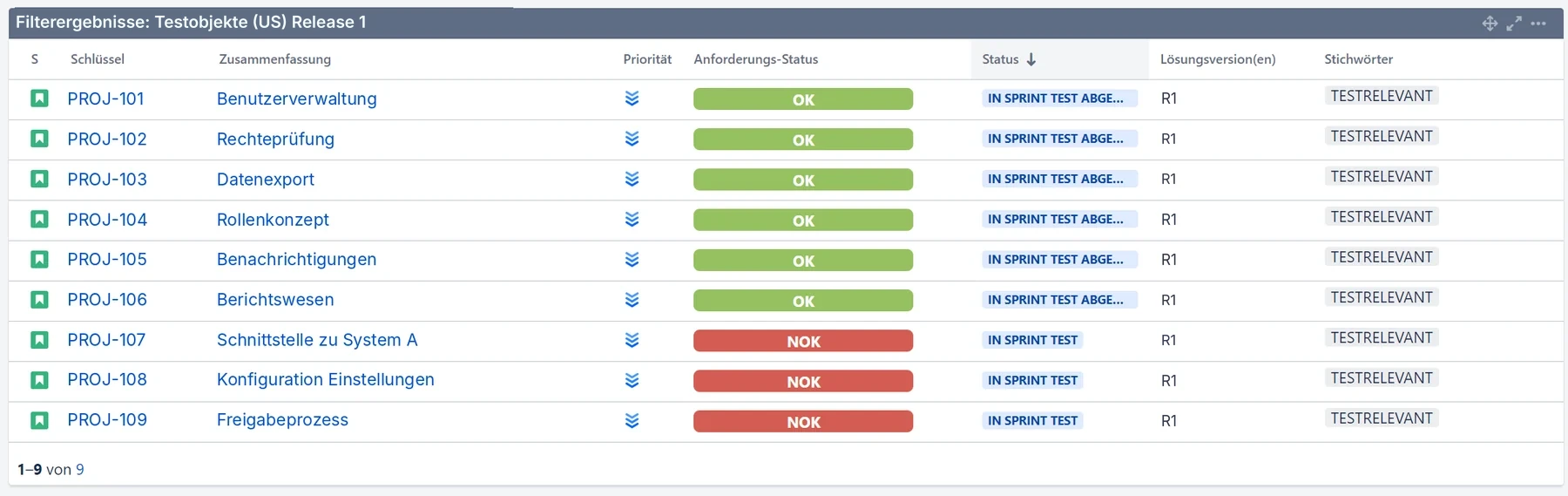
We make it visible how well each requirement is covered: from work status and test status to test coverage of epics, stories and releases, in real time.
- Traceability: requirement ↔ test case ↔ test execution ↔ defect
- Test status directly on the requirement, without manual reconciliation
- Test coverage per epic, story and release
Clarify requirements to be testable: Example Mapping and BDD →
Five phases, adapted to your project landscape
The methodology does not begin and end with testing. It connects requirements, planning, development, test and release into one continuous process.
- 01
Assess
Current-state analysisMake the project and system landscape, risks and maturity transparent.
- 02
Govern
Set the rulesDefine test strategy, quality gates and release criteria together.
- 03
Enable
Build the foundationProvide tools, test environments and the release process.
- 04
Execute
Verify qualitySteer feature, integration, end-to-end and acceptance testing. UAT with exploratory testing →
- 05
Steer & Report
DecideReport progress, risks and quality in a decision-ready form.
Where we apply test management
Insurance & Financial Services
- Complex system landscapes with many interfaces
- Integration testing across application boundaries
- Governance and auditability
SAP Transformations
- SAP logistics, SCM and EWM
- Quality assurance for S/4HANA programmes
- Test coordination across rollouts and countries
Jira/Xray in the Enterprise
- Introduction, migration and scaling
- Traceability and reporting dashboards
- Processes for distributed teams
AI-Assisted Quality Assurance
- Requirements analysis and acceptance criteria
- Test case derivation with Atlassian agents
- Team review before anything is adopted
Tool-neutral: Jira/Xray, SAP Cloud ALM, OpenText ALM
The approach does not depend on the tool. We implement it with Jira and Xray, with SAP Cloud ALM when test management lives there, and with OpenText ALM and ALM Octane. Even when a switch is coming up, for example because Atlassian Data Center is ending, the method stays the same. White paper on the end of Data Center →
Jira, Xray, Confluence
Requirements, tests and defects in one chain.
SAP Cloud ALM
Test management in the SAP project, linked to processes and requirements.
OpenText ALM and Octane
Classic and agile test management from one vendor.
Typical causes of quality problems
In our experience, most problems do not arise during testing itself but before and after it.
Starting too late
- Tests are planned only after development
- Requirements are not written in a testable way
Unclear release decisions
- No defined go/no-go criteria
- Decisions made ad hoc instead of on data
Lack of transparency
- Status scattered across spreadsheets instead of one system
- Reporting does not answer the decision-maker's question
Test management: questions and answers
What is the difference between test management and test automation?
Test management plans, steers and evaluates all testing. Test automation is a tool within it that takes over repeatable checks.
When does an external test manager make sense?
For example in programmes with many interfaces, in releases with several parties involved, or when a project needs transparency and an independent view of quality.
Do you work with Jira and Xray?
Yes. We use Jira and Xray for traceability, test status and reporting, and support introduction, migration and scaling.
Do you use AI in test management?
Yes, AI agents support requirements analysis and test case design. The team reviews every result before it is adopted.
How do requirements become testable?
By having business, development and test clarify each story together before implementation, for example in Example Mapping. The test cases come out of the examples. How this works is described on the Requirements Management page. To Example Mapping and BDD →
Are there templates and guides to download?
Yes. The Downloads page offers guides on Example Mapping and UAT, a test charter template, a white paper on the end of Atlassian Data Center and a service overview. To the downloads →
Do you also work with SAP Cloud ALM?
Yes. The approach is tool-neutral. We implement it with Jira and Xray, and likewise with SAP Cloud ALM when test management lives there. The comparison on the Test Tools page shows the differences.
Let us talk about your project
Briefly describe your project. We will get back to you with a first assessment.